
Repurposing Zion Lutheran School
Adaptive reuse will allow the historic space to be retrofitted for housing
By Maureen Callahan
Adaptive reuse is defined as the conversion of an existing building for a purpose other than it was originally built or designed. Look around, and you’ll see it in our local municipalities. Homes are now dental offices or architectural firms; former churches are exhibit spaces, and factories are loft apartments.
The concept is to utilize buildings that would otherwise be torn down – a viable alternative to new construction that considers costs, aesthetics, and sustainability. Adaptive reuse is also a great way to preserve memories as the purpose of a space is updated, such as in the case of the former Zion Lutheran School at Second and Vine Streets, just west of downtown.
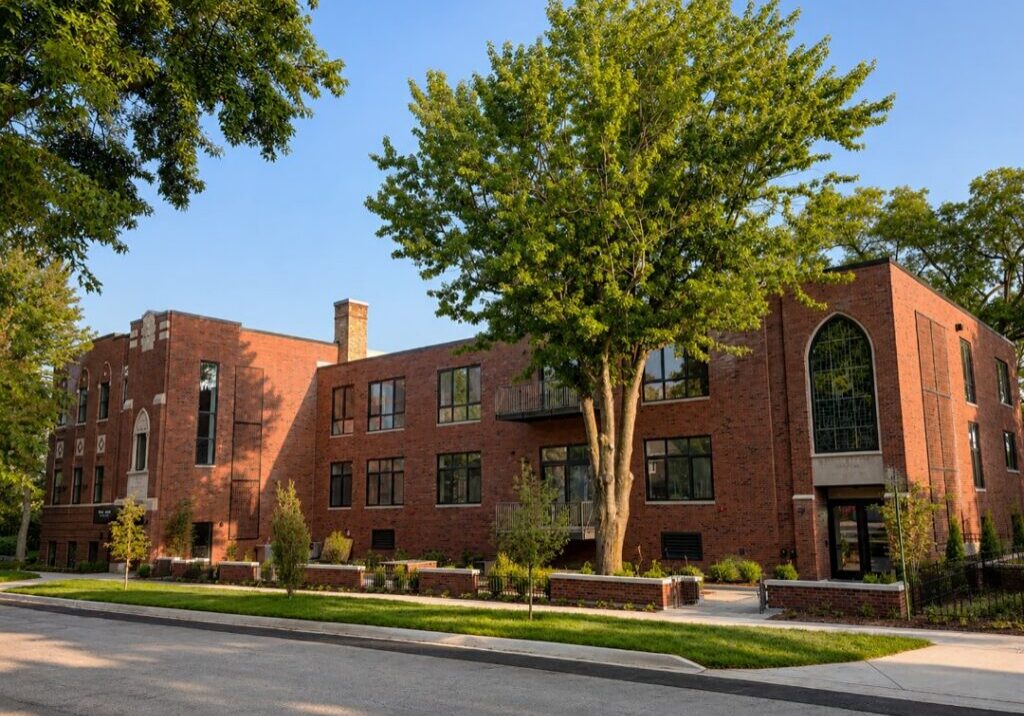
For over a century, Zion Lutheran School was a pillar for generations of students seeking a Christian education. The second building to house the school -now 95 years old- has been repurposed. (The original building was a one-room schoolhouse built in 1890). The 30,000 sq. feet, once partitioned by classroom walls, is now a 55+ community known as The Vine, which has seven private residences.
The footprint of the original building itself is almost identical to the school except for the addition of balconies and new windows. The roof and masonry, along with the stunning stained-glass windows, will remain – a way to incorporate the past alongside the modern overhaul of the beloved institution.
“The great thing was that the project is a win-win situation for the town,” said Craig Ross, of Ross Builders, the third-generation Hinsdale builder on the project. “The town of Hinsdale, as well as its residents, are very conscientious not to overbuild. While the building has been used for several other purposes since the school closed, we have created a new permanent use for the space.”
The project illustrates what’s possible with an older building given a new purpose. Without a doubt, repurposing has its challenges. There’s always a certain amount of unpredictability – it’s unknown what is behind a wall or above a false ceiling, until contractors get to work on that area of the project. There can be uncertainties that lead to additional costs, as opposed to putting up a new building that has been designed for a specific purpose.
“I think it’s great when we’re able to reuse existing buildings.”
– Bob Barnett
Downers Grove Mayor Bob Barnett has wonderful memories of Zion Lutheran. As a graduate of Zion, Barnett is happy about the repurposing of a building for which he has great memories. He attended the school from kindergarten through eighth grade. “Like many of the neighborhood schools, Zion was a fairly small community,” he said. “But the difference was that the kids came from all over – not every family was church members.”
Some came from as far away as Plainfield. Most stayed from kindergarten through eighth grade. Tight-knit communities were created over those formative years spent in the same classrooms.
One of Barnett’s favorite memories, along with many students of the 70s and 80s era, was that of Language Arts teacher and basketball coach Jim Brackensick. “Mr. B. had a big booming voice; he was a presence,” Barnett recalled with a smile. “There used to be a small house several doors down from the school that operated as a little store. My classmates and I always tried to sneak over there at recess to get candy. If Mr. B. caught you, you’d end up running laps around the schoolyard.”
“I think it’s great when we’re able to reuse existing buildings,” said the mayor. “For example, the gym had a high ceiling. It’s now going to be the parking garage.”
But the benefits – both environmental and from a preservation standpoint – are significant. There is less demolition waste, which saves space in landfills and reduces carbon emissions. Adaptive reuse is also a realistic way to reduce urban sprawl in a quaint village like Hinsdale and keep the historic charm alive – one reason many of us love our communities.