
From Boardrooms to Exam Rooms
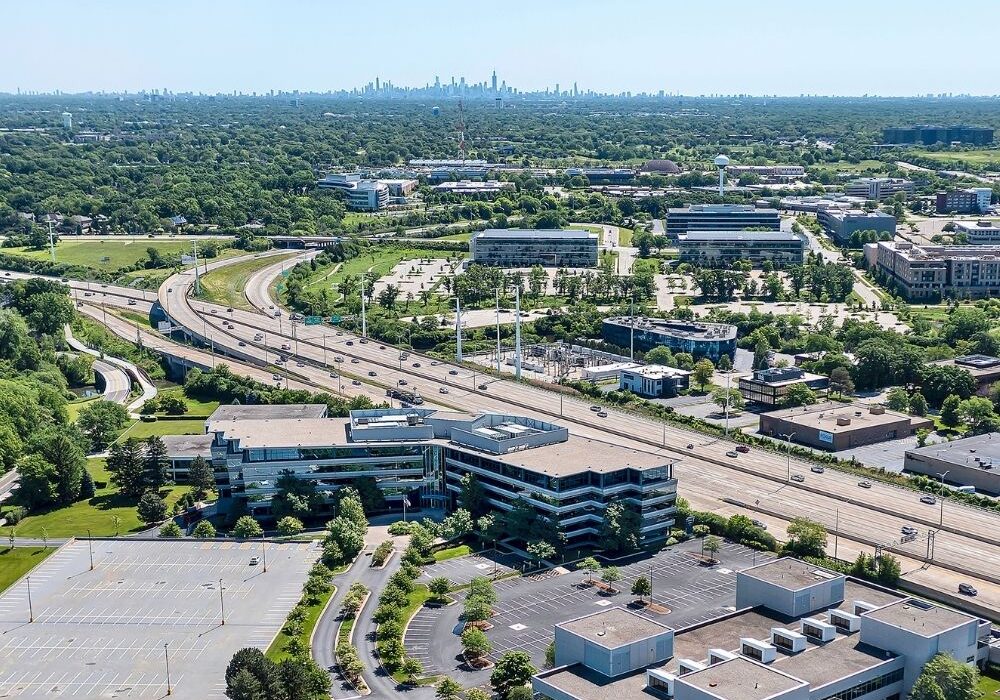
Photo courtesy of CBRE
Why medical offices are moving into corporate space
For decades, Oak Brook has stood as one of the western suburbs’ premier business destinations. Corporate headquarters, professional service firms, and regional offices were drawn to its polished campuses, central location, and seamless access to major highways.
Today, those same buildings are undergoing a quiet but significant transformation.
Walk up to any office directory along 22nd Street or York Road, and the shift is immediately visible. Where law firms and financial services once dominated, medical practices are increasingly taking their place, including orthopedic groups, dermatology clinics, imaging centers, and outpatient surgical suites. Spaces originally designed for board meetings and corporate operations are now being reimagined as centers for patient care.
The change is not happening by accident. It reflects two powerful trends unfolding simultaneously.
First, the traditional office market has been recalibrating. In the years following the pandemic, many companies reduced their physical footprint as hybrid and remote work became more common. Even organizations maintaining office space often require less of it, leaving portions of suburban buildings underutilized.
“Healthcare tenants are very ‘sticky,’ meaning they commit for longer terms because it’s expensive to relocate once they’ve built out their space.”
– Brian Edgerton
At the same time, healthcare delivery itself is evolving. Advances in technology, procedures, and patient care models have made it possible for many treatments to move beyond hospital campuses into outpatient settings.

Brian Edgerton
“Lower-acuity services—like primary care, pediatrics, and urgent care—are increasingly moving closer to where patients live and work,” said Brian Edgerton, Executive Vice President of NAI Hiffman, a commercial real estate firm active in suburban office and medical leasing. “It’s a more convenient and cost-effective way to deliver care.”
That evolution has created a natural alignment between healthcare providers and suburban office environments.
Office buildings already offer many of the fundamentals medical users need: accessible locations, ample parking, elevators, and professional, easy-to-navigate interiors. For patients, that often translates to a simpler, more efficient experience compared to large hospital campuses.
That alignment is particularly strong in Oak Brook.
Positioned at the intersection of several major highways—including I-294, I-355, I-88, and I-55—the village provides convenient access from across DuPage County and surrounding communities. Patients from Hinsdale, Downers Grove, Elmhurst, Clarendon Hills, and Burr Ridge can reach Oak Brook quickly, often without the congestion associated with downtown medical centers.
The corridor is already home to a growing concentration of healthcare providers, including major outpatient facilities from Northwestern Medicine and Midwest Orthopaedics at Rush, further reinforcing its role as a regional destination for care. Nearby, Ann & Robert H. Lurie Children’s Hospital of Chicago has also announced plans for a new outpatient facility in Downers Grove, reflecting the broader regional shift toward accessible, community-based care.
From a real estate perspective, those advantages are hard to replicate.

Perry Higa
“These areas offer strong demographics, high household income, and proximity to both patients and major healthcare systems,” said Perry Higa, Executive Vice President of NAI Hiffman.
Industry experts consistently point to the same combination of factors, like access, visibility, and affluence, as key drivers behind healthcare’s expansion into the Oak Brook corridor.
For building owners, the shift also represents a strategic opportunity.
Medical tenants tend to operate differently from traditional office users. While corporate tenants may downsize or relocate based on workforce trends, healthcare providers often make long-term commitments tied directly to patient populations and infrastructure investments.
While healthcare has become a growing solution for some properties, it is not a one-size-fits-all answer. Not every office building is ideally suited for medical use without thoughtful planning, infrastructure, and long-term investment.
“Healthcare tenants are very ‘sticky,’ meaning they commit for longer terms because it’s expensive to relocate once they’ve built out their space,” Edgerton explained.
Those buildouts are not insignificant. Converting office space into medical use often requires substantial upgrades, from additional plumbing systems and specialized exam rooms to improved accessibility and patient drop-off areas. Buildings may also need to accommodate higher parking demand, longer operating hours, and increased daily foot traffic.
While those requirements can be complex, they often result in stable, long-term occupancy—an increasingly valuable asset in today’s evolving office market.
The transformation is also reshaping the patient experience.
Instead of navigating sprawling hospital campuses, many appointments now take place in smaller, more focused outpatient environments. These settings are designed for efficiency, offering streamlined visits, convenient parking, and locations closer to home.
In many ways, the shift reflects a broader rethinking of how and where care is delivered. Healthcare is becoming more decentralized, moving into communities and adapting to the rhythms of everyday life.
Oak Brook is uniquely positioned within that evolution.
What began as a corporate hub is steadily becoming a hybrid environment and one where business and healthcare coexist, and where buildings once defined by boardrooms are now equally associated with exam rooms, imaging suites, and same-day surgical care.
The change is subtle in appearance but significant in impact.
And for residents across the western suburbs, it represents something increasingly important: access to high-quality care, closer to home, in a place they already know how to reach.