
Groove Foundation
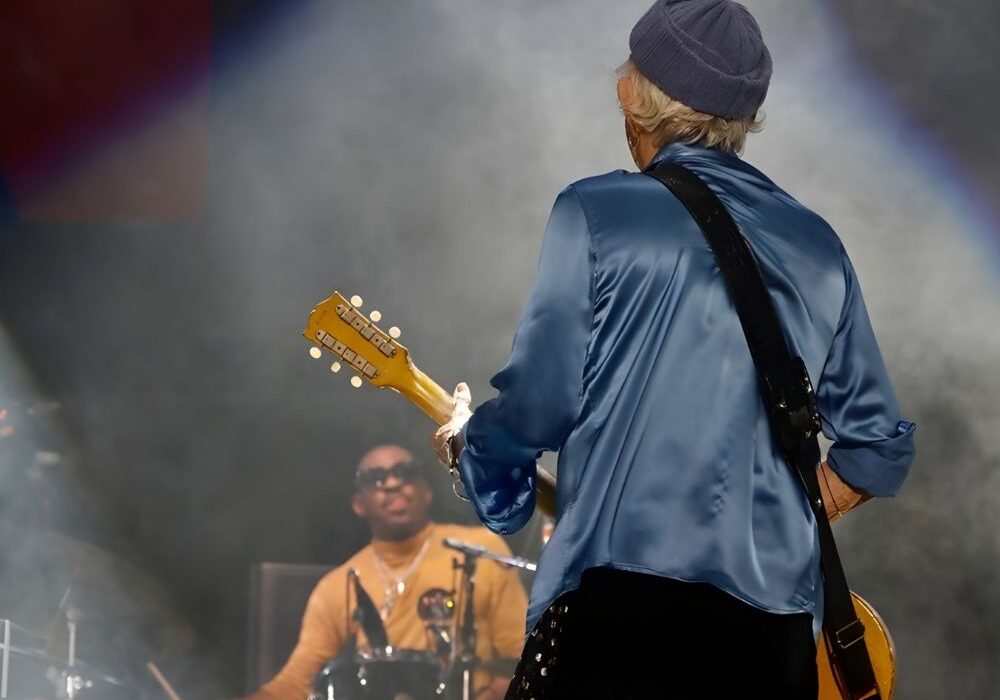
Photo by J. Bouquet
In an exclusive recent interview, Hinsdale Magazine Group sat down with legendary musician Steve Jordan. The Rolling Stones drummer opens up about his extensive musical career and his deep commitment to philanthropic work.
Steve Jordan loves making music. This philanthropic, legendary drummer with strong musical ties to Chicago says, “Growing up in New York at the time I did, New York had the best Board of Education. That meant on the first day of school, when you came home, you either had an instrument or a paintbrush, because the arts were an integral part of creating your full personality. That’s the way I grew up, and it enabled me to be creative freely and not think that you were doing something that had no future.”
Regarding whether he picked up drumsticks that first day of school, Jordan admits he was always banging on something. “In my family, and families like mine, music is central to life. Whether you’re a musician or not, you listen to music one way or another. It’s a way to express yourself, and it usually brings joy to the household.”
“Steve Jordan, where do I start? The fact that Charlie Watts said ‘If I’m not around, Steve is the man’ True enough, although I was not expecting it to develop into such a deep friendship and musical collaboration. We love working together, even for fun. I just turn around and see that beaming face…That’s Rock’n Roll!!”
— Keith Richards of the Rolling Stones

The last time Steve saw Charlie Watts play was in Chicago in 2019.
Photo courtesy of Steve Jordan
“If you play or not, music is important.” Able to identify songs he liked from a young age, he notes, “My parents, loving music themselves, were very supportive and would go out and get me records I liked. I started collecting 45s at a very early age. I began studying percussion at the age of eight. My life changed dramatically when I saw The Beatles on Ed Sullivan. That really fueled the fire for my desire to want to make music and take it more seriously.”
One of his first jobs was working at a rehearsal and music rental place on 52nd Street off 8th Avenue called Bill’s Music Rentals. “I was still a student at Fiorello H. LaGuardia High School of Music & Art and Performing Arts, and I worked in the percussion cage after school. Bill was a wonderful guy. He was a champion of mine. He saw something in me that maybe I didn’t even see myself. I got a lot of support when I was growing up. My parents were very supportive. I had people in the neighborhood that were very supportive because they saw my passion for the music. I love making music!”
While Jordan was working at Bill’s, Stevie Wonder was rehearsing and auditioning drummers. “Bill thought I should get an audition. Fusion music was in fashion, and Stevie and I broke out playing the song ‘Hymn of the 7th Galaxy‘ by the band Return to Forever. I was in the studio like every night with Stevie Wonder. It was crazy because it was like a Cinderella thing. I had to leave by a certain time because I only had money to get on the train, and if I didn’t get on it, I wouldn’t be able to get home because I lived in the Bronx. It was very surreal; even when I think of it now, it’s hard to believe.”
Another advocate was Denny Morouse, a horn player who played with Stevie Wonder. “The very first recording session of my career was a record session with Denny in Studio B at Electric Lady,” Jordan recalls. “The players in the session included Stevie Wonder’s bass player Nathan Watts, guitarist Michael Sembello, and my good friend, guitarist Carlos Alomar, who was in David Bowie’s group and co-wrote ‘Fame’ with Bowie and John Lennon. It was wild!”

(L to R) Tamio Okuda, Meegan Voss, Steve Jordan, Chris Bruce.
Photo credit Danny Clinch, Steve Jordan, Tatsu Okuda
While he has too many career highlights to list, he notes, “I’m fortunate enough to say things keep getting better and better. For instance, last year, my wife, Meegan Voss, and I toured with our band The Verbs. We toured Japan, and it was our most successful tour. Probably the most gratifying tour that I’ve ever been a part of. We did 11 shows. We hit all of our favorite Japanese cities. Great crowds, and we debuted some of the new material from the album that we’re making now, called Garage Sale. That was amazing.”
“I’ve toured with the Stones a couple of times. Obviously, that’s been incredible. I became friends with Charlie Watts when I was 19 because I was doing SNL. The Stones did the first show of the fourth season of SNL. That’s when Charlie and I met and became friends. So, I’ve known these guys for a long time.”
“I grew up listening to James Brown basically every day, and I can tell you the highlight of my career on television was in July of 1982 playing with him on Late Night with David Letterman. That was his last great performance on television, and he said it was his greatest performance in front of cameras since the T.A.M.I. Show.”
Jordan recently returned from playing with Jon Batiste at the World Economic Forum in Davos,
Switzerland, and then Muscle Shoals, Alabama, to record and produce with Robert Cray. “Some of my favorite records were made in Muscle Shoals. We went to this magical place, FAME Studios, to make this record. I’m so glad I did it. It was an incredible experience thanks to Rodney Hall and his mother, Linda Hall. We had a great time.” He adds, “Speaking of highlights, probably in my recording career, besides creating a record label with Meegan called Jay-Vee Records, and aside from our band, we signed Bettye LaVette, we signed Robert Cray, and we did a record with Mix Master Mike and myself.”
They also have a Tony Joe White record coming out this year and are completing a film about the late R&B architect Willie Mitchell. “I do a lot in Memphis at Royal Studios. I first went down there because I took Keith Richards there to co-produce his first solo album, Talk is Cheap. We co-produced it and co-wrote all the songs. He had these beautiful chord changes, and I suggested we put a Willie Mitchell groove to it.
“In my family, and families like mine, music is central to life. It’s a way to express yourself and it usually brings joy to the household.”
— Steve Jordan on growing up around music
Instead of just trying to emulate his horns in New York, I told Keith, ‘You’re Keith Richards. You can go to Memphis and get Willie Mitchell himself.’” That 1987 trip sparked a lifelong friendship with Mitchell and his family, who embraced them and eventually gave Jordan permission to direct an authorized documentary on Mitchell’s life. “We are going to complete it this year, finally. It’s the first Jay-Vee film. We’re very excited about it.”

Bruce Willis, Quincy Jones, and Steve Jordan at the Jazz Foundation of America Annual Vibrato Event in LA
Photo courtesy of Steve Jordan
“I love producing records. I love being in the studio. I’m very proud of the records I’ve either produced or co-produced. One recording that I’m really fond of is John Mayer’s Continuum. That record has influenced a generation of young musicians. Obviously, John is incredibly gifted in many ways, and to see him grow… I got to witness this guy blossom. It’s just amazing. I call him a very dear friend. He’s like a brother. But it’s exciting to know that you watched this guy turn into the guy that he turned into. He’s brilliant.”
On the best part of his work, he shares, “The best part of what I do is that you go into the studio with nothing, and then you come out with something. And that’s great! It’s like a blank canvas, and you take your brushes and your paints, and you start painting, you start creating. Whenever the recording process becomes not fun, you shouldn’t do it. The most fun for me in my life is that I married my closest friend. She’s also my partner, my songwriting partner, and my bandmate. I knew a relationship like this was possible, and that’s what makes it so much fun. Because the music I care the most about, I make with the person I care most about. So, that’s wild!”
‘The first time I collaborated with the Jazz Foundation of America [which is my primary philanthropic organization] was actually because the Blues Foundation Memphis was putting together a show [at The Apollo] and they didn’t have a New York license. Chicago blues guitarist and singer, Hubert Sumlin was instrumental in helping plan the event, as was Eric Clapton. Hubert passed away before the show. All of us ended up doing a tribute to him during the performance, which included Eric, Keith Richards, James Cotton, Buddy Guy, Gary Clark, – you name it. We put together a fantastic show and raised a ton of money! After that, one thing led to another and my involvement with JFA grew organically”.
“The great joy of this work is being a part of the incredible camaraderie of the artists.”
— Joe Petrucelli, Executive Director, Jazz Foundation of America
Discussing his and Meegan’s roles as artistic directors of the New York-based Jazz Foundation of America, he explains, “I knew that there were a great many people that I was acquainted or friends with that would need assistance one day. Because when I was coming up, everybody was 20 years older than me. Now, everybody I play with is 20 years younger than me. But by the time I started doing this, I saw some of those people having health issues or not working as much. They needed assistance in one way or another. Health issues, tax issues, mortgage issues, whatever. And to find out that this organization did all that was revelatory. The thing that really sealed the deal for me about JFA was their discretion about their cases. Nobody knows unless you want people to know that you are being assisted by JFA. That to me is extraordinary because, in this society, everybody wants to take credit for something. They were assisting a very dear friend of mine when he got throat cancer. He was a singer. He wasn’t able to sing for a while. He had a kid. He was a first-call kind of singer. And they were helping him, and I had no idea. He never talked about it, and they didn’t advertise it. Abbey Lincoln and Odetta want people to know JFA is helping them, so you can shine a light on the foundation. Roberta Flack did the same thing. A lot of people think once you have a certain level of stardom, you will never need any kind of assistance. Nothing could be further from the truth. Nothing.”
“A lot of people think once you have a certain level of stardom, you will never need any kind of assistance. Nothing could be further from the truth. Nothing.”
— Steve Jordan
“Philanthropy to me just means helping people in need, that’s all. It’s very simple. And if you have the means to help, then that’s what you do. Before I had any kind of money, I would try and find a way to help in any way I could, because you can help people even if you don’t have a single cent. You can be there just to listen to them as they voice their concerns. Some people just need someone to listen to what they have to say. I got that from my parents. They did that for and to everyone they knew. So that just trickled down.”
In addition to the Jazz Foundation’s recently launched Jazz Legacies Fellowship with the Mellon Foundation, “The next thing we’re working on is housing. It will be a complex for artists who need assistance. That’s the next big thing for us. We saw this during COVID. When the clubs shut down, you didn’t realize how many musicians relied on the club to feed them during the sound check and the show; they would get dinner. Now, not only is there no gig, there’s no food!”

Having fun at Chess Records. Steve Jordan next to photo mural of Willie Dixon, Muddy Waters, and a young Buddy Guy.
Photo by Chess photographer Don Bronstein, Sept. 1963.
If he weren’t involved in music, “I would probably be active in the community politically because when you grow up in New York City, you learn about politics immediately. We talked about it every night at the dinner table.” He attributes his civic-mindedness to his family, noting his sister was a schoolteacher and both parents were civil servants. His father, an architect, became the supervisor of the architectural section of the City of New York, while his mother eventually became the assistant to the commissioner of human rights for the City of New York before she retired. “I’m kind of active anyway. In fact, I’m very active. I’m not an elected official, so I don’t have those constraints on me.”
Jordan fondly recalls a conversation with former JFA Chairman of the Board, Dick Parsons: “One show at the Apollo, we were standing in the wings, and he leaned over to me and said, ‘I want to make this foundation an institution,’ and I’ll never forget that. That’s how I think of the future of the Jazz Foundation. Through our partnership with the Mellon Foundation, we are going in that direction. We’re elevating not only our profile but our effectiveness.”
Feeling fortunate to work with the team at JFA, he adds, “It’s like a family. You don’t get the opportunity to step into a situation like this very often. All I have to do is stay on path and do the right thing, not get in the way, and just do the right thing.” Regarding The Rolling Stones’ upcoming album, Jordan shared that they recorded in May of last year and “had a blast”, which included working
with Stevie Winwood. While unsure of the exact release date, he hinted that a second, unreleased track recorded with Paul McCartney during the Hackney Diamonds sessions, which fulfilled a childhood dream of his, might be included in the new record.
“I’m looking forward to working with Buddy Guy again. And, of course, there’s only one Buddy Guy. I haven’t worked with him in about a decade. I just want to do him justice and get the best record outta him. We’re going to celebrate his 90th birthday—it’s gonna be awesome!”
For more information, visit info@jazzfoundation.org 212.245.3999
Special thanks to Bridget Sullivan, Joe Petrucelli & everyone at JFA.
Steve Jordan:
- A world-renowned drummer for the legendary rock band, The Rolling Stones.
- Inaugural member of the Blues Brothers, Paul Shaffer & the World’s Most Dangerous Band, Keith Richards & the X-Pensive Winos, Super Soul Banned, and John Mayer Trio.
- Collaborated and worked with icons Chuck Berry, Etta James, Buddy Guy, B.B. King, Aretha Franklin, Eric Clapton, Bruce Springsteen, Sheryl Crow, Beyoncé, Alicia Keys, and many more.
- Co-founded the band The Verbs and the record label Jay-Vee Records alongside his wife and musical collaborator, MeeganVoss.
- Renowned throughout the industry as a Grammy Award-winning producer and an Emmy Award-winning director.
- Curator of the ‘Let’s Play Chess’ 75-year Anniversary anthology.
- Director for the acclaimed biographical film, Cadillac Records.
- Deeply dedicated to honoring and supporting the artists who originally paved the way for modern music.
- Serves as the artistic director of the Jazz Foundation of America with his wife, Meegan Voss.
- Music director of Michael J. Fox Parkinson’s Foundation.
- Serves on the Board of Directors for the National Dance Institute.