
A Local Indiana Jones

Dr. James Henry Breasted spent a lifetime in pursuit of history’s mysteries
Most towns cannot claim a local Indiana Jones. Downers Grove is very proud of the legacy of Dr. James Henry Breasted. This world-renowned explorer, archeologist, scholar, and linguist was the first American Egyptologist. He grew up here and was one of five graduates in Lincoln School’s (now Lincoln Center) inaugural class in 1879.
There have been speculations that Breasted was the inspiration for Dr. Indiana Jones. Like the movie character, he was an archaeologist and professor at the University of Chicago in the 30s.
Breasted was born in Rockford in 1865, as the Civil War was ending. His father, Charles Breasted, was a pharmacist. When his business was destroyed in the Great Chicago Fire, the family started over in Downers Grove. Breasted grew up here from the age of eight until he left for college. Charles Breasted bought 20 acres of farmland and built a home on Main St. (now Highland Avenue), nicknamed The Pines.
His ordinary childhood was anything but a telltale of the extraordinary life he would go on to lead. Young Breasted tended the animals on the family farm, played in the marshes among the birds, and fished and swam at Prince Pond. The family attended the First Congregational Church on Curtiss St., where he studied the Hebrew Chronicles in Sunday school. At the time, no one knew he would go on to become one of the world’s most prominent authorities on ancient languages.
At age 15, he enrolled at Northwestern College in Naperville (now North Central College) where he studied chemistry and botany. He also studied Latin. Breasted received a degree – the first of many – from Chicago College of Pharmacy. He worked a short stint in the pharmacy at the corner of Main and Curtiss in Downers Grove. But he wasn’t fulfilled.
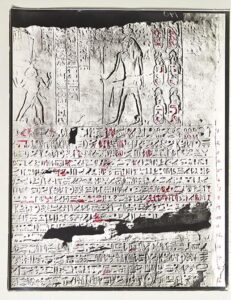
A page of Breasted’s journal
Breasted felt compelled to preach the gospel. He enrolled at Congregational Institute (now Chicago Theological Seminary) to study Hebrew. After he graduated from the seminary in 1890, he went on to study ancient languages at Yale.
As Breasted compared original biblical texts to the King James Bible, he saw firsthand the inaccuracies. In his heart, he felt he could not knowingly preach a scripture that held so many discrepancies. It was then that Breasted realized his passion for accurate translation. It became the hallmark of his storied career and a quiet compromise between a life of preaching and academics.
By the time Breasted graduated with his master’s degree from Yale, he could speak, write, and translate 12 languages. A Yale professor in the process of founding the new University of Chicago promised Breasted a teaching position in Egyptology if he earned his doctorate. Breasted enrolled at the University of Berlin – the world’s think tank at the time – for eastern languages and Egyptology. He graduated in 1894 as the world’s first American Egyptologist.
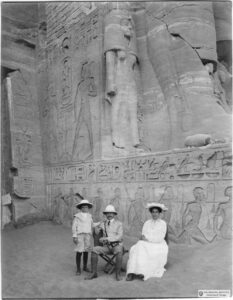
Breasted Family at Abu Simbel Temples, Egypt
He married Francis Hart, a fellow American classmate in Berlin. The couple honeymooned on the Nile. Entire days (and many moonlit nights) were spent copying inscriptions at various sites such as the Temple of Karnak in Luxor. Breasted was adamant that the hieroglyphs on the temple walls be copied and translated before being lost to weather, erosion, and time. It was of the utmost importance to him.
Throughout his career, he copied ancient texts. From Egyptian coffins in museums to the walls of temples and pyramids themselves, the projects often took years at a time. His translations were recorded in journals and then published. They are still used by students in the field today.
Upon the couple’s return from their honeymoon, Breasted was appointed Assistant Director of the Oriental Institute Museum at the University of Chicago (now the Institute for the Study of Ancient Cultures). He also held an assistant professorship in Egyptology, the only department of its kind in the country at the time.
Over the next three decades, Breasted taught and led numerous archeological expeditions to Egypt, Turkey, Mesopotamia, Babylonia, Palestine, Jordan, Iran, Iraq, and other destinations. Often, he had students and his family in tow. A friendship with John D. Rockefeller Jr. opened new doors for archeological quests. As Breasted’s level of professional significance grew, so did his ability to wheel, deal, and fundraise.
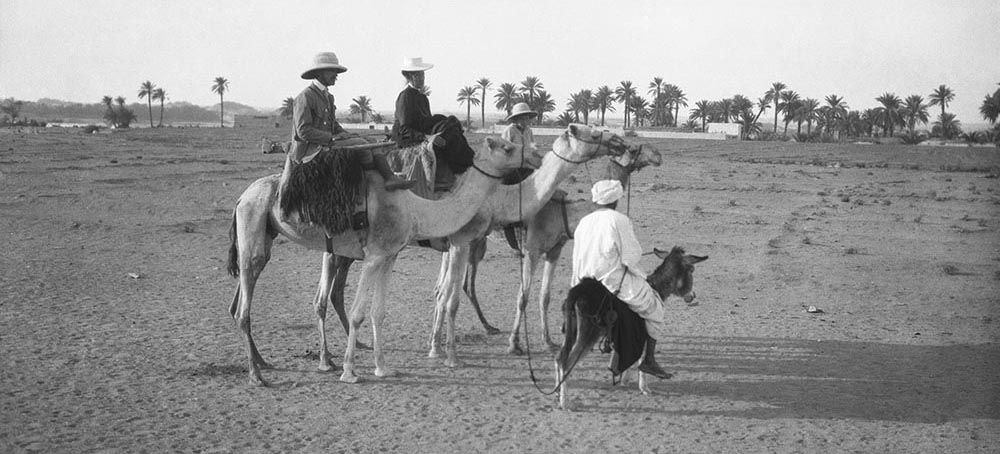
He once spent an entire day bargaining for four mummies. When he won them, he hired camels to haul them across the desert to the Nile. They were loaded directly into his bedroom on the barge, where he slept next to them that evening. They were shipped to the Oriental Institute the next day.
Massive alabaster figures from King Sargon’s palace (circa 700 BCE) in Persia, are among the treasures of the Oriental Institute. The twin figures weigh 40 tons each and stand 16 feet high. The process Breasted followed to handle, protect, and transport these pieces along dirt trails to a port where they were shipped to Chicago is formidable.
Breasted became a rainmaker for Chicago’s growing collection of antiquities. Not only the Oriental Institute, but also the Art Institute and the newly established Field Museum, reaped the largess. The professor became an expert in haggling with other collectors. He often outbid institutions like the Louvre or British Museum for rare and valuable artifacts. Chicago became the American epicenter of the study of Egypt and the Fertile Crescent – a term he coined.
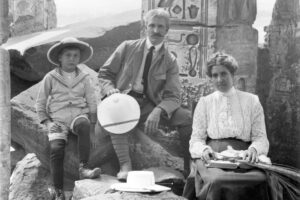
Breasted and family in Egypt
Breasted’s defining discovery was in 1922 when the world-renowned archeologist witnessed the opening of the burial chamber of King Tutankhamun (Tut). As the field’s foremost authority on hieroglyphs, he was called into the project by colleague Howard Carter to decipher the seals imprinted on the crypt. It was Breasted’s word that verified the tomb to be that of the ancient Pharaoh – the find of the century!
A curse of death was believed to follow anyone who opened Tut’s tomb. To dispel any rumors, Carter, Breasted, and others involved in the dig had lunch in the tomb of Ramses VI, adjacent to Tut’s burial chamber.
In 1932, Downers Grove celebrated its centennial year. By then a very busy man, Breasted still made time to visit his childhood home. Locals recalled him sharing his thoughts and memories of growing up here. He recounted fond memories of the village school, which laid the foundation for his lifetime of scholarship. In 1980, exactly a century after his graduation from the former Lincoln School, the auditorium at Lincoln Center was named for Dr. James Henry Breasted.
Breasted died in New York, NY, on December 2, 1935, of an infection he picked up on an excavation dig. He is best remembered for recognizing the ancient Middle East’s influence on the formation of Western civilization. He literally made his mark on the world by copying and deciphering ancient symbols before nature eroded them.
Breasted’s son, Charles Breasted, published Pioneer to the Past, a biography of his father’s life, which contains numerous references to Downers Grove.