
What’s Cooking?
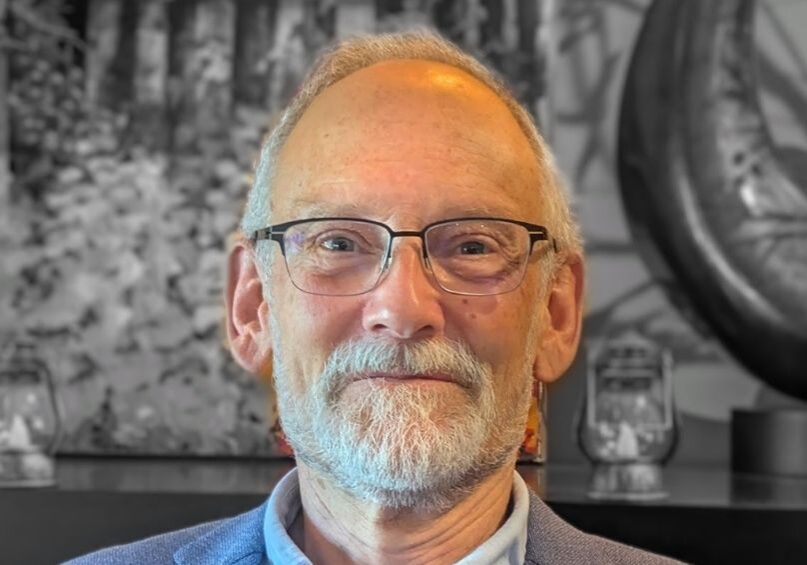
World-renowned kitchen scientist and writer Harold McGee has Elmhurst roots.
Have you ever wondered why you like your chili extra spicy while someone else would require a half roll of Tums to get through the bowl? Or why a sommelier might use words such as “leathery” or “floral” to describe a particular wine? And why DO onions make us cry?
Kitchen scientist Harold McGee wondered all of these things. While he studied applied sciences like chemistry and physics in school, he became much more curious about the science we use in everyday life, such as when we cook.
For McGee, we all become chemists when we cook. He has given the last five decades of his life to a discipline he helped to create – kitchen science. Not surprisingly, his name is now among the most respected in the field of gastronomical education.
What exactly is kitchen science, you might wonder? While some might mistake it for food science – the study of food composition, quality and safety – McGee’s area of study focuses on the science of what happens when food is cooked and why. “Right now, we’re in a moment in time when science is having this strange and highly publicized impact on cooking,” said McGee. “In reality, the relationship between science and cooking goes way back.”
For a long time, culinary studies were not paid much respect by academia. McGee’s work did a lot to change that. Today, he is widely regarded as one of the most influential and important people in the world of food.
McGee’s interest in science began at an early age. While he currently lives near San Francisco, he grew up in Elmhurst, which he remembers as having big green spaces and dark skies at night.
The York High graduate became interested in astronomy at an early age, which guided his path to the California Institute of Technology (Caltech). As he hammered away at the typical science and mathematics courses alongside his freshman classmates, he realized he wasn’t as interested in the nuts and bolts of astronomy as he was in the effect astronomy has on us as people.
Although he almost left the university to pursue a more humanities-based course of study at a liberal arts college, his professors persuaded him to stay and finish at Caltech. “They knew I would be able to take courses there that I would never find anywhere else in the world,” said McGee.
He went on to Yale the following year, where he earned a PhD in literature. He taught everything from writing to poetry to Homer and James Joyce at Yale, as he hoped to find a tenured position.
“Tenured track positions were as difficult to come by then as they are now,” said McGee. “So, I decided to write about the science of everyday life – food and cooking.”
McGee was curious as to why Julia Child always recommended using a copper bowl when making a meringue. What difference would it make to use a glass bowl? A dead-end library search on the science of protein foam inspired him to perform his own experiment in his kitchen with the help of some friends. A hypothesis tested that night led to a tongue-in-cheek paper the group submitted to Nature Magazine.
And that’s how it started. If life is about timing, McGee’s was perfect. There was plenty of room on the uncharted frontier of kitchen science back in the 70s. This was the pre-specialty-coffee-drink era. Boutiques that carry dozens of types of olive oil hadn’t opened yet.
“I started writing when the food scene was still kind of quiet,” said McGee. “The whole culture of food and cooking was in the process of changing just as I began to write.”
Another experiment employed the help of some physicist friends simulating heat transfer on a computer through foods. The group proved that the faster they flipped a steak on the grill, the faster and more evenly it cooked through.
McGee left his teaching job in 1984 to write his first book about kitchen science, On Food and Cooking: The Science and Lore of the Kitchen. But the book was slightly ahead of its time. “It sat on the shelves for a while,” McGee recalled. “Food was just becoming something people were interested in on all fronts.”
While it took some time for people to see the science of cooking as a worthwhile subject, it was all worth it. Now in its eighth hardcover edition, On Food and Cooking is required reading in culinary schools and universities across the world and is translated into several languages. It began to be recognized as the book culinary students used to answer questions they hesitated to ask their professors.
In his second book, The Curious Cook, published in the 90s, McGee dispels many culinary myths and helps the reader learn how to keep salads greener and meats tender while braising. The book led to a spinoff column of the same name in The New York Times, written by McGee, in which readers could have culinary questions answered.
A third book, Keys to Good Cooking, published in 2010, takes the particulars of culinary chemistry and applies them to everyday situations with alternative techniques. Don’t want to waste quarts of water and energy to boil pasta? Try adding just enough water to cover the noodles and heat the mixture.
Just as a physician’s scope is bigger than his practice, McGee’s books cover a huge breadth of topics most kitchen manuals would never touch, such as the difference between Scottish Whisky and its Irish counterpart or how to make a sauce similar to a heavy French hollandaise without the hassle.
Topics such as tips on everything from help choosing ingredients to safety tips on storing food to suggestions on improving imperfect recipes can be found in his work.
While McGee has been recognized as Bon Appétit Magazine’s Writer of the Year, he is ironically bothered by the concept of the perfect recipe. As a matter of fact, McGee’s approach is almost the opposite of that of most cooking magazines. “People want different things from their food,” McGee has learned. “Sometimes the process is as important as the result. The more readers understand, the more they can make their own decisions.”
His most recent book, Nose Dive: A Field Guide to the World’s Smells (2020), explores the science of smell and taste, a subject that has piqued his interest throughout his career.
While McGee’s path might have meandered more than a traditional one, he managed to create his own niche in the market – the science of cooking -just as the space became available.

Left: McGee frequently lectures on the science of food, helping chefs, students and home cooks better understand what happens in the kitchen.
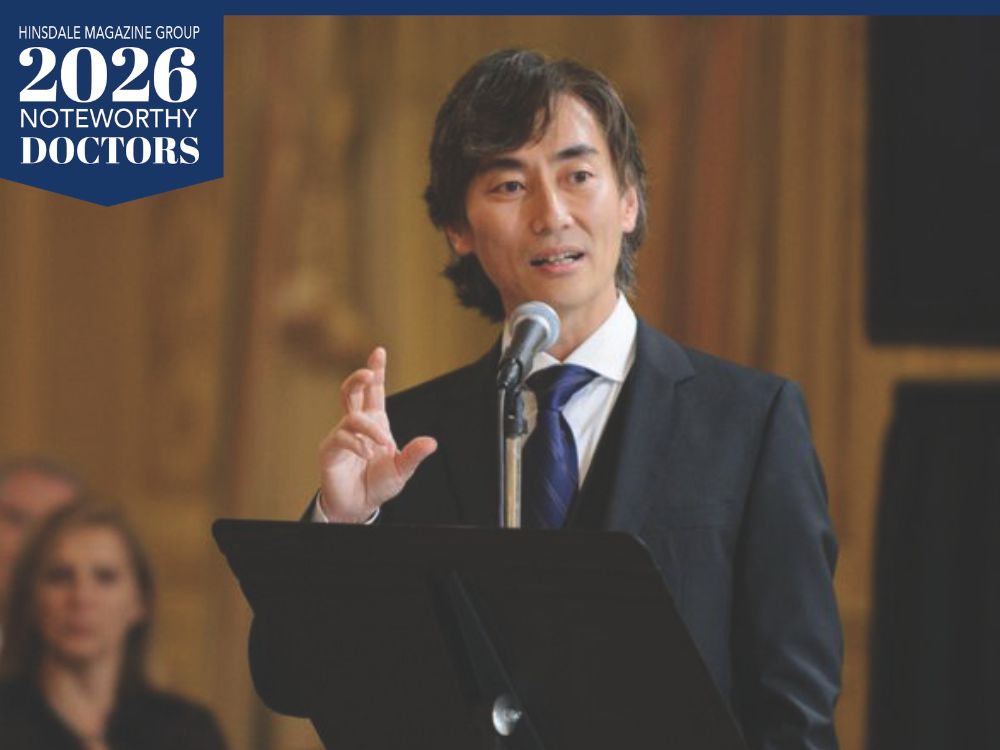
Right: McGee’s work is rooted in experimentation, testing the scientific principles behind common culinary techniques.
HAROLD McGEE’S ESSENTIAL WORKS
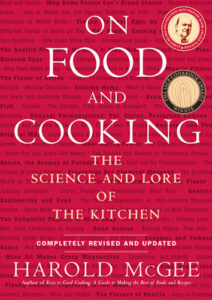
On Food and Cooking (1984)
The groundbreaking book that helped establish kitchen science as a serious field of study.
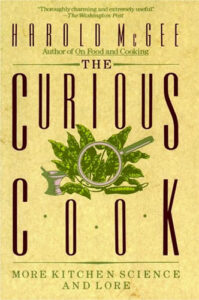
The Curious Cook (1990)
A collection of experiments, myths and answers to common cooking questions.
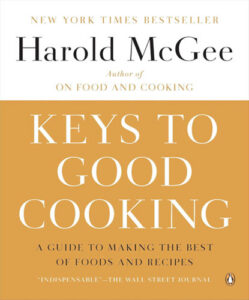
Keys to Good Cooking (2010)
A practical guide to understanding cooking techniques and solving kitchen problems.
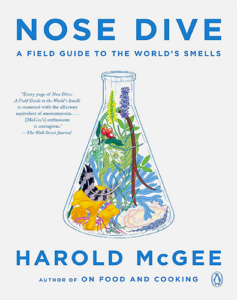
Nose Dive(2020)
An exploration of the science of
smell and its connection to taste.
HAROLD McGEE’S ELMHURST MEMORIES
Before becoming one of the world’s leading kitchen scientists, Harold McGee was a typical Elmhurst kid.
“I attended Edison, Sandburg and York,” McGee recalls. “I climbed the backstops and hit golf balls in the open space between them. Our family would sometimes have picnics at Wilder Park, and I spent a lot of time in the library there.”
He also remembers visits to the newly opened Lizzadro Museum, afternoons at East End Pool, movies at the York Theatre, and stopping at a nearby diner for a Coke and fries.